
Geometry!
Geometry is something you will have been familiar with even before you knew the word itself. It finds itself everywhere around us, in the shape of the screen you're looking at to the angle with which you see it. In this free learning resource, we'll plunge into the world of shapes, angles, and lines, covering the basics of Geometry.
"Geometry is nothing at all, if not a branch of art."
Basic Shapes
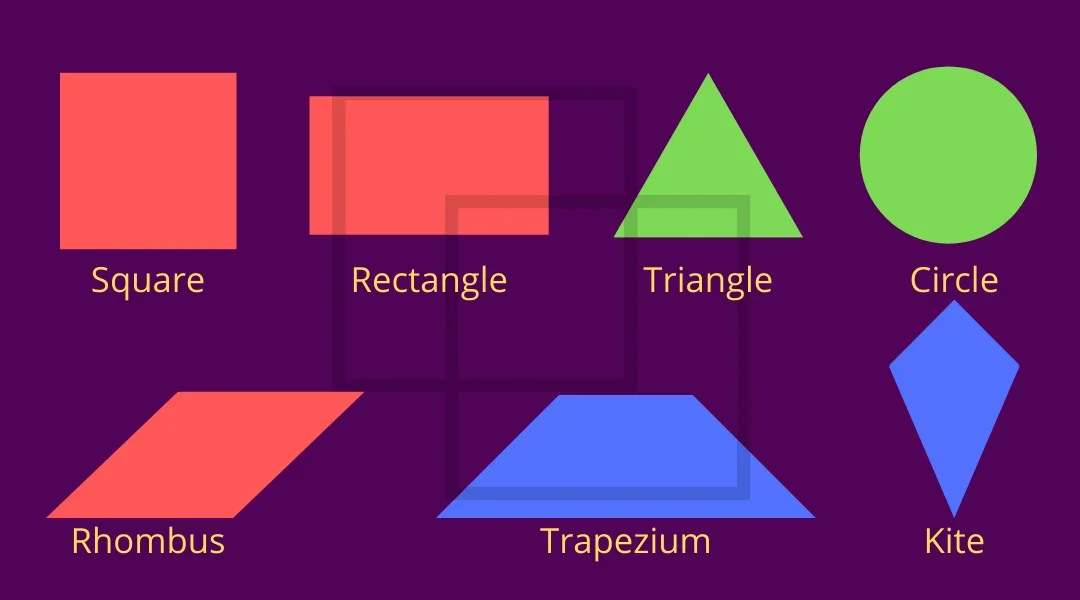
Firstly we'll look at the basic shapes. These are the shapes that you have seen many times (Square, Rectangle…) and maybe some you haven't seen (Kite, Trapezium).
We can split these shapes up into three basic categories, quadrilaterals (shapes with four sides), parallelograms (quadrilaterals with opposite sides parallel) and non-quadrilaterals. Remember, a parallelogram is a type of quadrilateral.
Square (Parallelogram)
A parallelogram with 4 equal sides and 4 equal right angles.
Rectangle (Parallelogram)
A parallelogram with 2 pairs of equal sides and 4 equal right angles.
Rhombus (Parallelogram)
A parallelogram with all sides equal.
Trapezium (Quadrilateral)
A quadrilateral with one pair of sides parallel.
Kite (Quadrilateral)
A quadrilateral with two pairs of equal sides adjacent to each other.
Triangle (Non-Quadrilateral)
A shape with 3 sides and 3 angles.
Circle (Non-Quadrilateral)
A round figure with no corners or edges.
Area and Perimeter
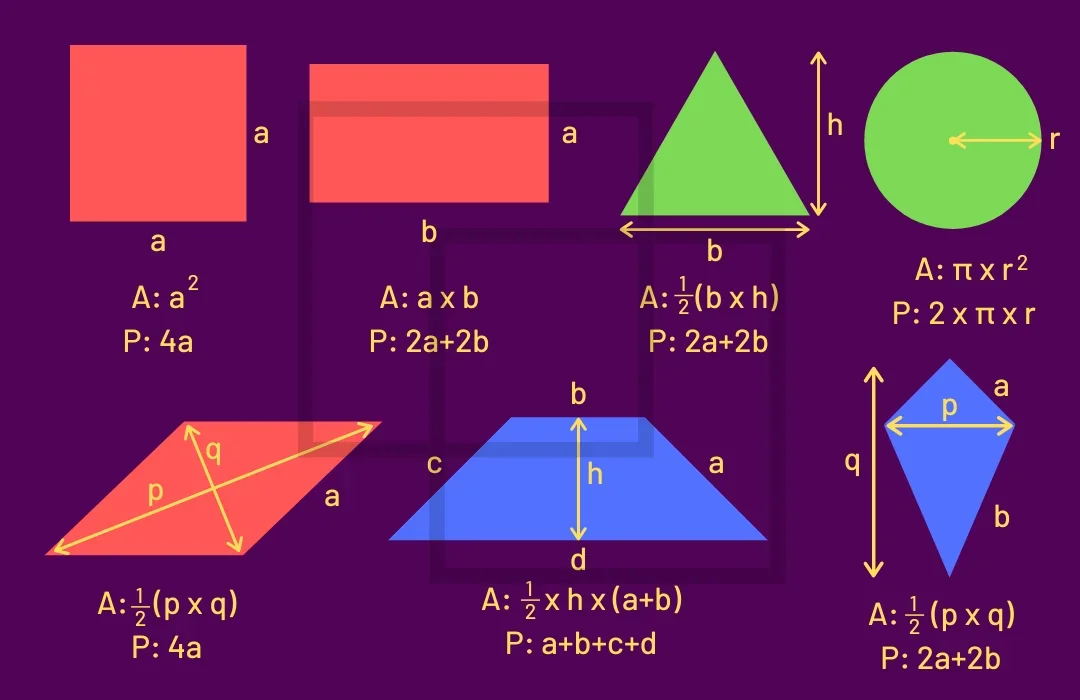
Two important elements of basic shapes are the Area and Perimeter.
Area
The amount of space enclosed within a flat shape.
Perimeter
The distance around the outside of a flat shape.
Surface Area and Volume
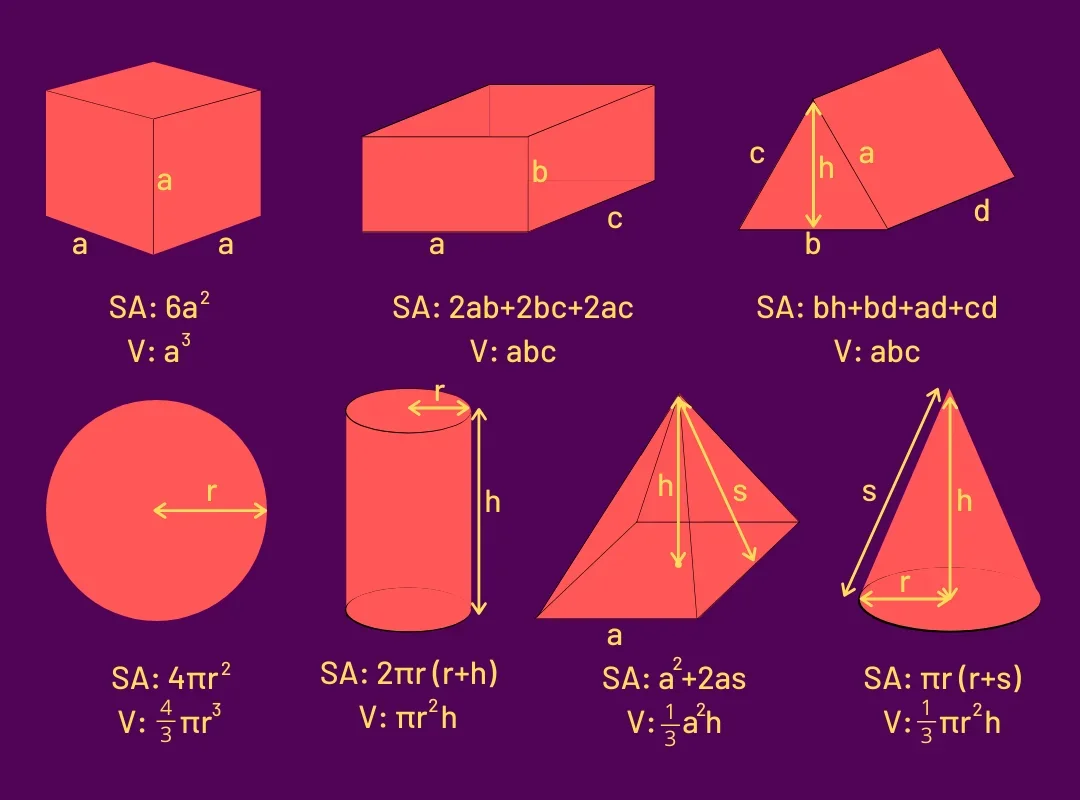
So far we've only been working in two dimensions. However, we live in a 3-dimensional world, and so we have 3 dimensional shapes, including the cube, rectangular prism, triangular prism, sphere, cone, pyramid, and cylinder. To understand these shapes, we'll look at 2 key concepts, Volume and Surface Area.
Surface Area (SA)
The total area on the outside of a 3D shape.
Volume (V)
The amount of space enclosed within a 3D shape.
Struggling with some calculations? Check out our Algebra Resource for some help in solving equations.
Angles
There are 6 main types of angles which you'll cover in school.
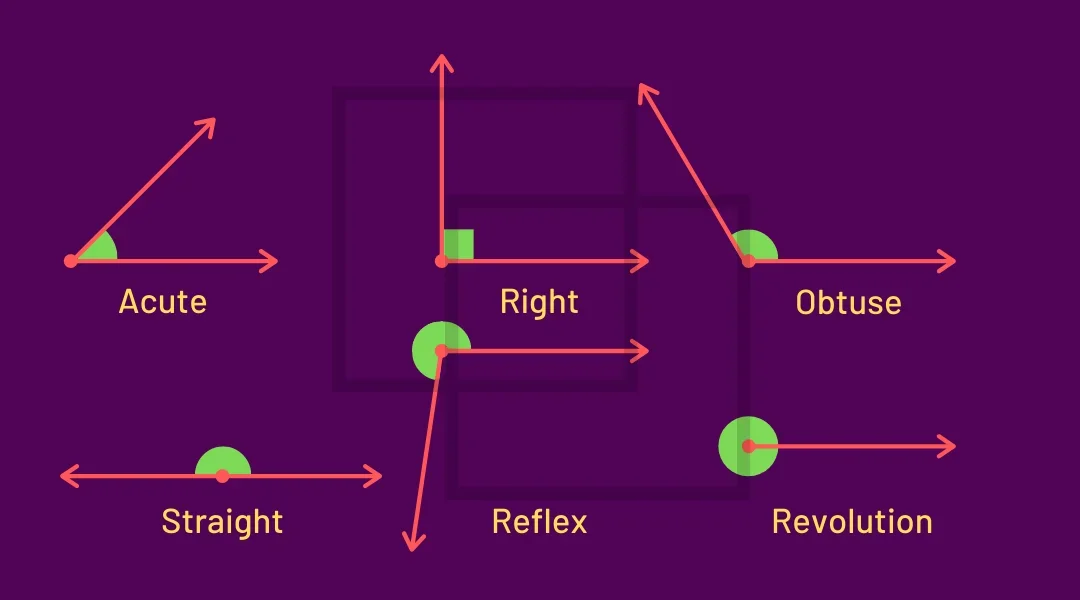
Acute
An angle that is between 0 and 90 degrees.
Right
An angle that is exactly 90 degrees.
Obtuse
An angle that is between 90 and 180 degrees.
Straight
An angle that is exactly 180 degrees.
Reflex
An angle that is between 180 and 360 degrees.
Revolution
An angle that is exactly 360 degrees.
Types of Triangles
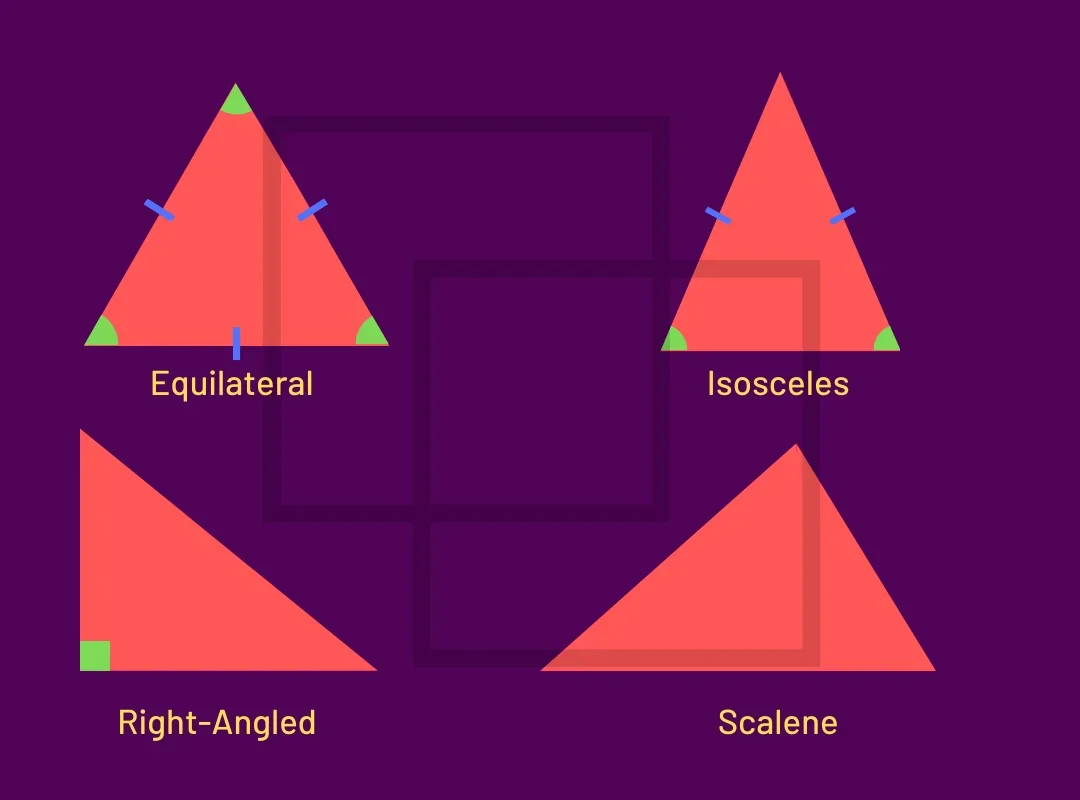
Triangles are a fundamental aspect of geometry, and so in this section, we'll dissect the 4 different types of triangle.
Equilateral
A triangle with all equal sides and equal angles.
Isosceles
A triangle with a pair of equal angles adjacent to a pair of equal sides.
Right-Angled
A triangle containing a right angle. The side directly opposite the right angle is called the hypotenuse and will always be the longest side of the triangle.
Scalene
A triangle with 3 different sides and 3 different angles.
Some More Terminology
Two ideas which are important in understanding geometry are Complementary Angles and Supplementary Angles.
Complementary Angles
Angles which add up to 90 degrees. Two angles in a Right-Angled Triangle which are not the right angle are complementary.
Supplementary Angles
Angles which add up to 180 degrees. Two angles which form a straight line are supplementary.
"Parallel lines have so much in common, it's a shame they'll never meet."
Parallel and Perpendicular Lines
Some of you may already be familiar with the concepts of parallel and perpendicular lines, but if this is new territory for you, here's a quick explanation.
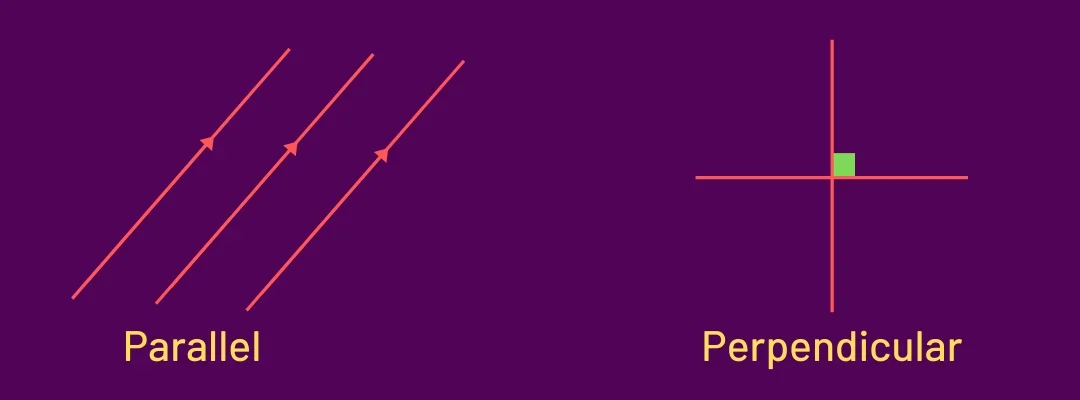
Parallel Lines
Two or more lines which will never meet. In textbooks, this is shown as two lines with arrows on them.
Perpendicular Lines
Two lines which intersect at right angles. In textbooks, this is shown as a box as the angle between the two lines.
Fun Fact! Parallel lines have the same gradient! Check out the Graphing Resource where we talk about gradient.
Some Special Angles
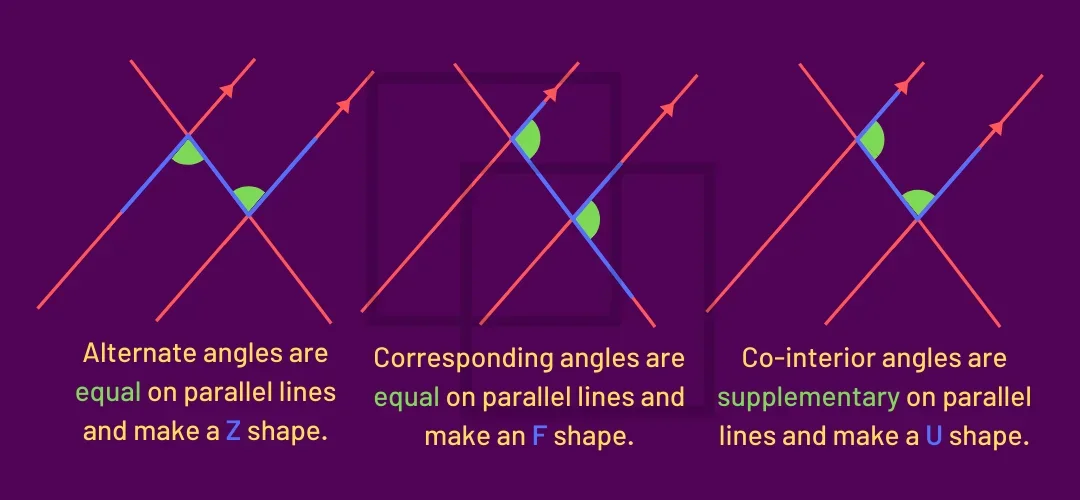
In this section, we'll look at three types of relationships between angles on parallel lines. But first, let's add a transversal. What's a transversal? Simply put, it's any line that intersects a pair of parallel lines.
Now let's look at these special angles, they are Alternate angles, Corresponding angles, and Co-interior angles.
Congruent and Similar Triangles
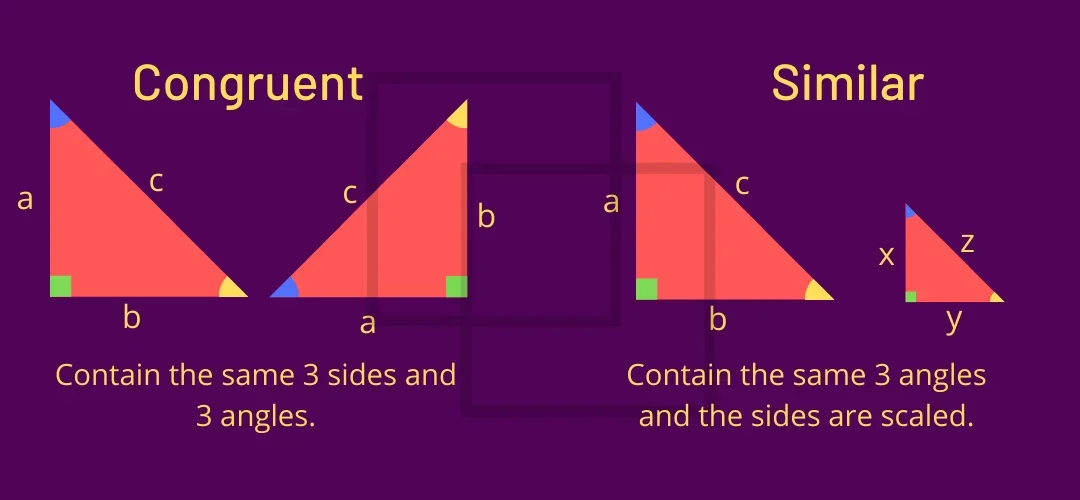
The next step of our journey into the world of Geometry is congruence and similarity. Note that these terms refer to a comparison between TWO triangles; to say a single triangle is congruent or similar is nonsensical.
Congruent Triangles
Two triangles are congruent if they have exactly the same size sides and angles. However, congruent triangles can be flipped and/or rotated.
Similar Triangles
Two triangles are similar if one is a scaled version of the other, that is, the angles are the same, but the sides may be scaled differently. Similar triangles can also be flipped and/or rotated.
The Big One … Pythagoras
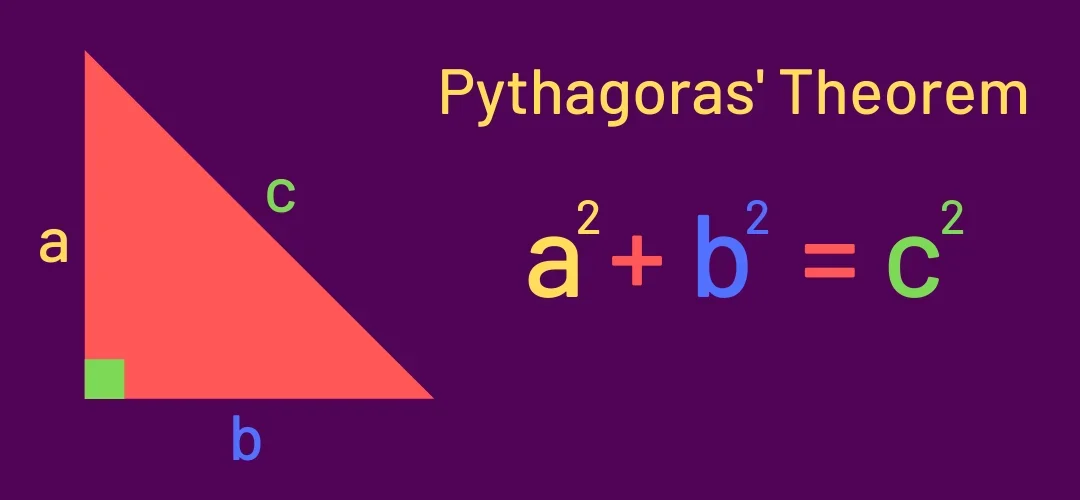
Pythagoras' Theorem
Next we'll move onto the famous Pythagoras' Theorem. To understand this theorem, we need to know the two shorter sides of a right-angled triangle as well as the hypotenuse. Remember, Pythagoras' Theorem ONLY works on right-angled triangles.
"It is the glory of geometry, that from so few principles, it is able to accomplish so much."
— Isaac Newton
Basics of Trigonometry
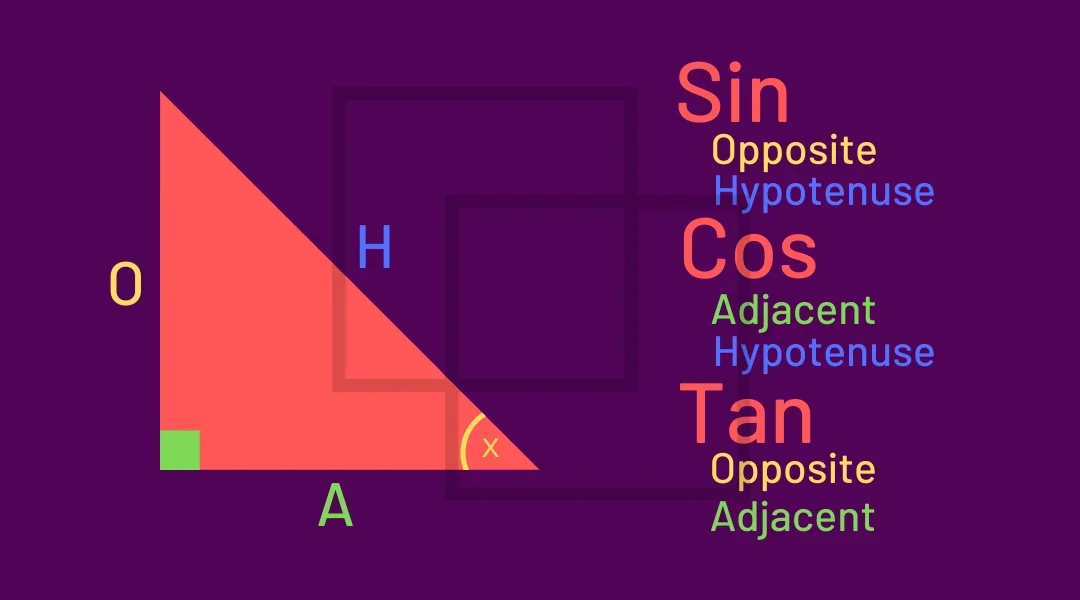
The last stop on our journey into Geometry is the basic trigonometric ratios, Sine, Cosine, and Tangent, which are commonly abbreviated to Sin, Cos, and Tan.
Like Pythagoras' Theorem, we'll only look at Sin, Cos, and Tan on right-angled triangles. Now let's let an angle (not the right angle) be x.
Sin
Sin(x) is the ratio of the side opposite to the angle (x) to the hypotenuse.
Cos
Cos(x) is the ratio of the side adjacent to the angle (x) to the hypotenuse.
Tan
Tan(x) is the ratio of the side opposite to the angle (x) to the side adjacent to the angle (x).
SOHCAHTOA
This is a useful abbreviation for remembering our trig ratios: Sin (Opposite/Hypotenuse), Cos (Adjacent/Hypotenuse), Tan (Opposite/Adjacent).
Want some help with Geometry?
Sometimes the internet just isn't enough and you really do need a mentor to guide you in person.
Smart Space offers in person lessons with engaging tutors. Maybe we can help you. Take a look at our Maths courses or book a free trial below.