
The Basics
What is a story?
Stories are happening every day! We tell them all the time. How about when you re-tell your day to your parents or share your dreams with your bestie? Yep, we are all storytellers.
But when it comes to writing stories in class, we tend to overthink it. Read on to find out the basics of creative writing.
This is the original Smart Space creative writing resource, structure, show don't tell, dialogue, character, and symbols and motifs. If you are a parent looking for a framework to coach your child through a piece of writing, read this alongside our newer guide, How to Help Your Child Improve Their Creative Writing.
Story Structure
There is a general format that you should follow when you craft your stories.
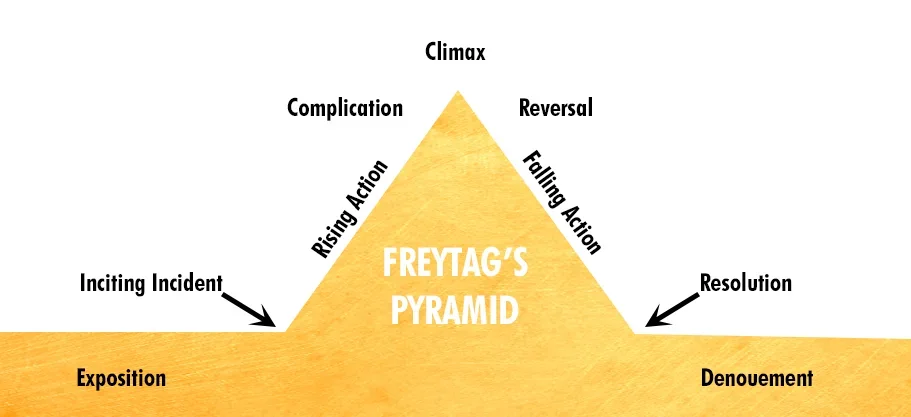
1. Exposition/Orientation
This is the first part your audience reads, so we want it to be engaging and interesting – we need a hook!
2. Rising Action
Things start heating up after the orientation. You guessed it, it's time to build tension; cue the rising action.
3. Climax
This is the peak of the drama, the turn in your story after which nothing will be the same. It must grip the reader and their emotions.
4. Falling Action
What goes up must come down! Now we're in the aftermath. Show the reader what good (or bad) has come of the main character's efforts.
5. Resolution or Denouement
What's the moral of the story? It should be satisfying and show what the character(s) have learnt.
Show Don't Tell
In creative writing the classic "Show Don't Tell" technique is not to be underestimated. Often when we write, we reveal too much too soon. The trick is to give away a little at a time and let the reader's imagination fill in the gaps.
Look at the graphic below, can you guess which one is 'showing' and which one is 'telling'?
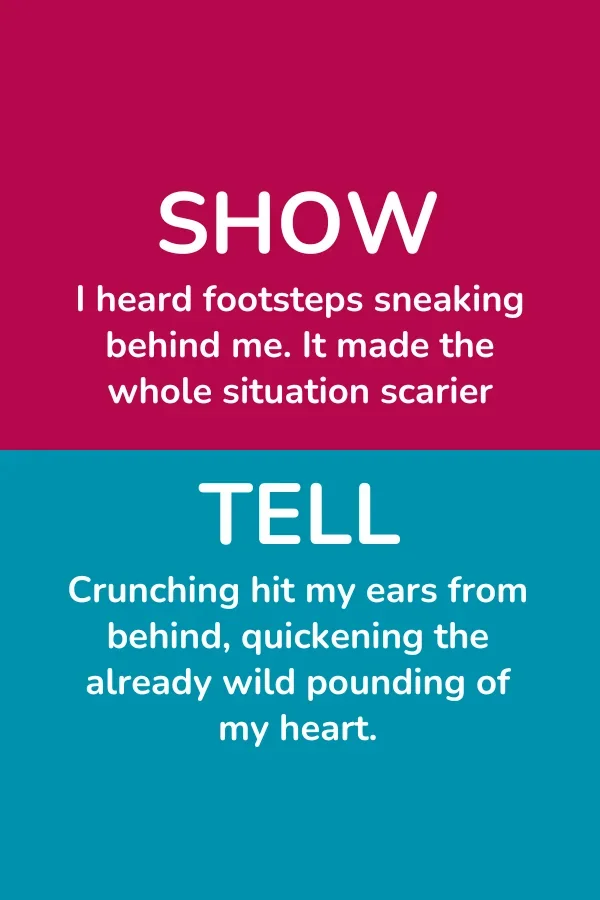
Telling
Telling is giving cold hard facts, blunt descriptions or telling the reader information without letting them use their imagination.

Showing
Showing is the opposite. It avoids exposition and instead uses dialogue, feelings, actions, body language to let the reader experience the story.
Showing is what makes the audience want to read on.

Just a side note…
We can't do away with telling altogether in creative writing. There are times when you need to skip over non-critical parts to get to the interesting stuff. You may need to set the scene or provide an explanation of an event, this is where telling is perfect.
Dialogue
We want the dialogue in our story to be real!
This is your chance to eavesdrop on people in the name of research! You want to avoid clichés and info-dumping.
Dialogue is only useful when it moves the story along and gives insight into the character and their relationships with others.
Character
When you're writing you want to create a believable character. It's best to base it on someone you know and add or modify from there – truth really is stranger than fiction.
Consider how your character will speak, think and act and be consistent.
Symbols and Motifs
The best short stories have strong symbols and motifs. Symbols are objects that represent other things but don't repeat across the story (those are motifs). A motif is a recurring element in your story that keeps your main idea or theme in focus.
A magnifying glass can symbolise investigation and mystery while the repeated presence of Harry Potter's scar is a motif for both the theme of love and his destiny to triumph over Lord Voldemort.
That's a wrap!
We hope the resource helped but sometimes you need a real life mentor to guide you through the twists and turns of creative writing.
Smart Space offers in person lessons with engaging tutors.
Book a FREE Trial Lesson today.