
Analysis and Expression
In this learning resource we're going to go through the basics of analysis and written expression!
Terminology
Whilst these terms get thrown around a lot, it's nice to recap on their meaning every now and then.
Textual Analysis
Analysis is a broad term but generally it refers to the process of unravelling or explaining a 'whole' by looking at its smaller parts.
For example, we might understand a novel more clearly by examining various individual sentences and quotes throughout it.
Expression
Expression is also a broad term but generally refers to the written communication used by a student.
Our expression should always be as clear and lucid as possible in order to avoid confusion and to communicate our meaning properly.
Textual Analysis
The most basic textual analysis is really just composed of these four elements.
Topic | Evidence | Technique | Evidence Analysis
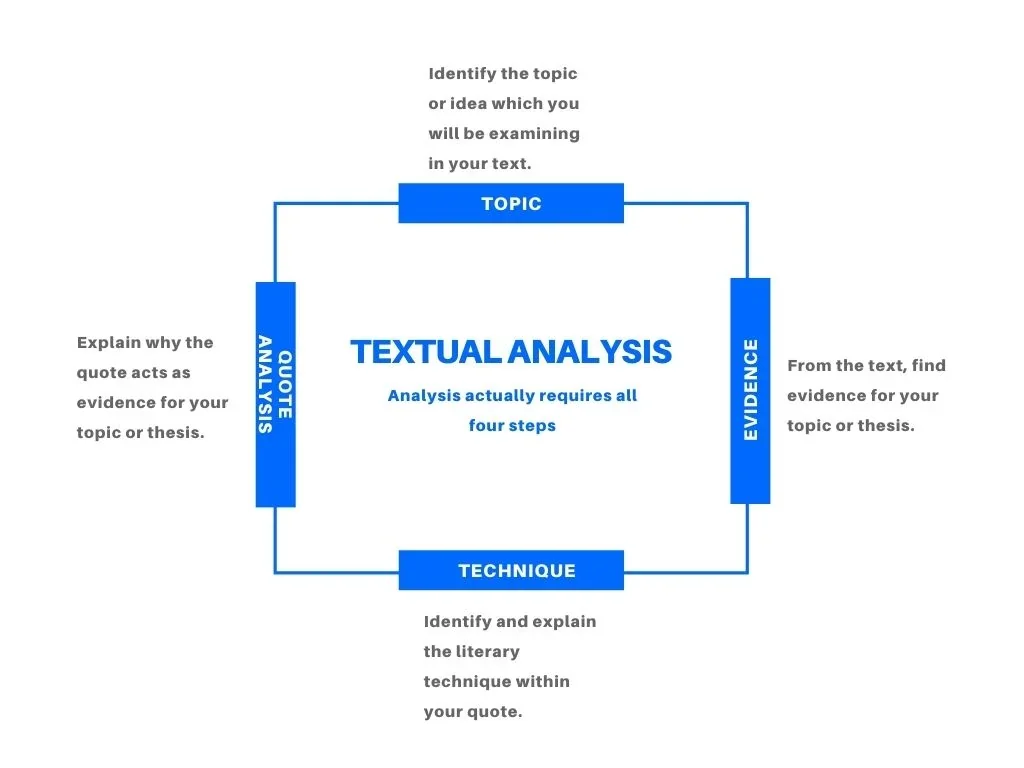
Topic
The "topic", also known as a Thesis, Theme, Idea, Postulate and many other terms, refers to the idea you want to investigate or "analyse" in a given text.
It is not possible for you to just generally "analyse" a text because there are a million different things you could be looking for.
Therefore, the first step is to always specify the topic which you are trying to investigate or analyse. With a clear topic or thesis sentence, we are able to start looking for evidence of that idea in the text.
Eg. Text One highlights the importance of courage through the protagonist Emilia and her willingness to help others even in the face of danger.
Evidence
As with any argument, once we have made a claim or proposition we must now provide evidence. In the case of textual evidence, this will usually come in the form of a quote.
A quote serves as evidence of your topic and is a citation taken directly from the text without alteration.
Eg. Emilia attempts to come to the rescue of stranded skiers in spite of the "bone-chilling cold" which cut through the skin "like a blade".
Language Techniques
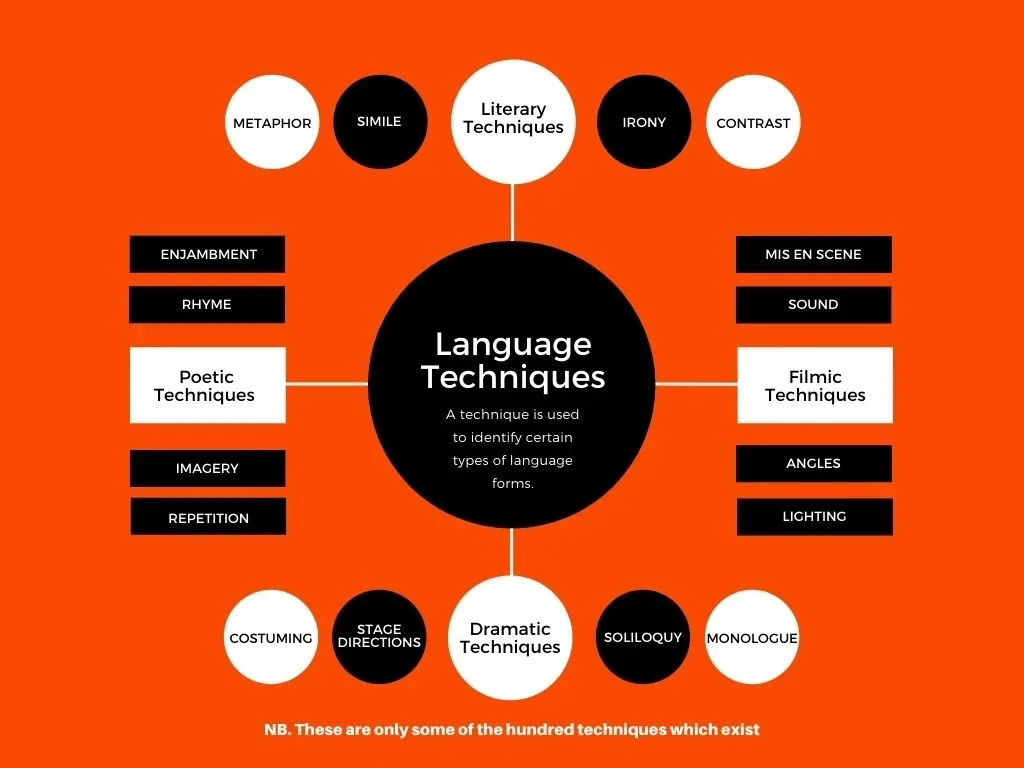
In the case of prose fiction, techniques refer to literary techniques which are used in the text to communicate meaning: simile, metaphor, symbolism, tone, repetition, etc.
Each one of these techniques will have a different effect in how they communicate an idea which is why it's important to recognise them and explain how they alter the meaning of a text.
Eg. Through the simile and subjective imagery, the author portrays the harsh and violent weather as a particularly menacing force that impedes Emilia's rescue of the skiers.
Analysis of Quote
An analysis of a quote means forming a clear connection between the quote and the topic.
You should expand and elaborate upon your quote to explain why it is demonstrative of your theme or idea and you must go farther than simply restating the literal events which occur in the quote.
Analysis is a broad term so take this with a grain of salt, but generally when your teacher says that you have "poor analysis" in your essay, it means that you did not clearly link the quote with your theme or that you only gave a literal repetition of the quote without going any deeper into it.
Eg. However, in spite of these frigid and painful conditions Emilia insists on helping the stranded skiers and in doing so demonstrates exemplary courage.
Textual Analysis Simplified
Textual Analysis, at its most basic level, is quite a simple four step process.
- Topic or Idea
Clarify what (Topic) you are trying to prove in the text.
- Evidence
Find evidence (Quote) of the topic in your text.
- Technique
Explain how (Technique) this evidence is communicated.
- Analysis of Evidence
Explain why (Analysis) this evidence is proof of your topic.
These are the basic principles of analysis but there is a second struggle. It is not enough to know something. You must be able to express it clearly.
"It doesn't matter how sophisticated, multilayered or impressive your ideas are if they cannot be communicated."
Expression
Expressing yourself clearly is the singular most important objective of studying English and whilst there are obviously a myriad of techniques to improve your expression, in this learning resource we will only address four basic methods.
Thematisation
To thematise an idea or word simply means to place the word at the start of a sentence in order to bring attention to it. You should always start sentences with the most important subject.
Eg. Which sentence is clearer?
- The awkward car ride as the father and son drive home in silence shows conflict between James and Kurt.
- The conflict between father and son is clearly shown in the awkward car ride between James and Kurt as they drive home in silence.
The second sentence is clearer because it thematises "conflict" and draws our attention to an important idea. Thematisation is a very basic technique but it's good to practise before you move onto more complex sentence formations.
Longer Sentences (25 words)
Writing short and truncated sentences can often have the effect of creating choppy and fragmented writing.
Wherever possible, it is best to write at least 20 – 30 word sentences so that you can expand upon your ideas and provide enough information about the subject.
This is a guideline, not a rule.

Be Specific
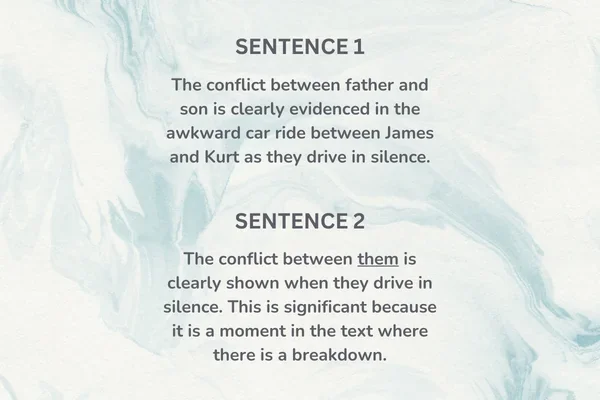
One of the simplest ways to improve your expression is simply to be specific. You should always try to provide as much detail as possible about the subjects and objects of your sentence.
Try not to use words like "this or that" or "something" and "stuff" not only because they are simplistic but because they are vague and do not have any definite meaning.
In the image below you can see the difference some simple details can make to either clarifying or confusing your sentence.
Flow
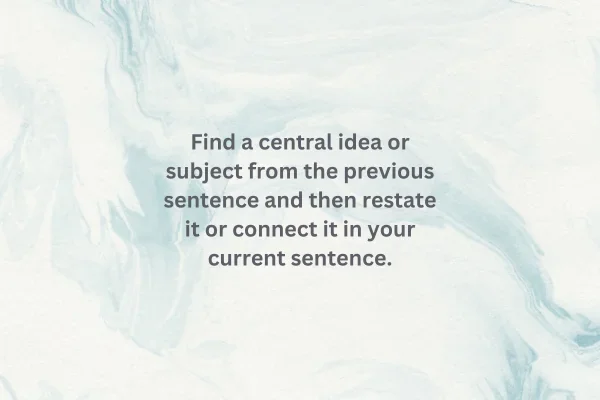
Flow simply means how well your current sentence links with your previous or following ones. In order to link your sentences you should try to find a central idea or subject from the previous sentence and then restate it or connect it in your current sentence.
Eg.
Previous Sentence: The conflict between father and son is clearly shown in the awkward car ride between James and Kurt as they drive home in silence.
Current Sentence: This silent drive is significant because it is the first instance in the text where there is a communication breakdown between the characters.
That's all folks!
We hope that this resource has helped clarify some basic details about analysis and expression though we know that sometimes the internet isn't enough.
If you're still feeling a bit bogged down in writing clear analyses Smart Space offers fantastic real-life tutors that can help!
Book a Free Trial today!